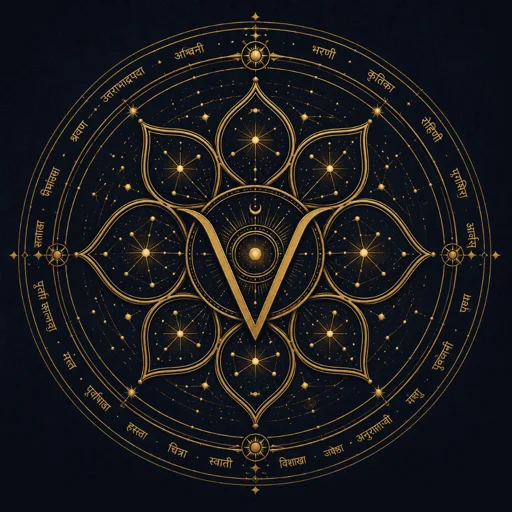
Birth star 9 of 27
Ashlesha
आश्लेषा
106°40′–120°00′ sidereal longitude
Ruled by Mercury · 9 of 27
The deep reader: shrewd, magnetic, sees what lies beneath.
The tradition links Ashlesha with penetrating insight and hold. People born under it are often described as perceptive, private and persuasive. The star is considered intense, best when that intensity is used with care.
Strengths the tradition names
- Reads people well
- Strong intuition
- Persuasive presence
Worth watching
- Guardedness
- Over-controlling when worried
In love
Described as deeply attached and hard to read at first. Trust is earned slowly, and closeness runs deep once it forms.
At work
Often suited to psychology, strategy, research or negotiation, where seeing beneath the surface is an advantage.
Why a cat and the serpents?
Its deity, the serpents, stand for hidden knowledge and coiled power. The animal, Cat, and the figure, a wheel, suggest stealth, patience and holding on.
If you know Western astrology
It sits in sidereal Cancer, so it shares Cancer's depth of feeling, with a more watchful edge.
These readings are Vediq's plain-English take on the tradition. The facts below them come from named sources.
Ashlesha
आश्लेषा
- Real stars you can see
- head of Hydra (ε, δ, σ, η, ρ Hydrae)
- the serpents
- Cat
- Rakshasa
Where these facts come from
- Surya Siddhanta ch. 8 (E. Burgess, 1860)
- Muhurta Chintamani 6.25-30 (Khemraj, 1879)
Make your Star ID
Your birth star on one card, sized for Stories and posts.
Drawing your Star ID…
Name stays here until shared.
Find it in the sky
Real stars
head of Hydra (ε, δ, σ, η, ρ Hydrae)
No junction star is identified in our verified data.
When to look
Look up in Mar–Apr evenings. This is an approximate season for mid-northern latitudes; local visibility varies.
Its god, animal and temperament
the serpents
Vedic name
Asresa
Classical figure
a wheel
: cat
Stars that share the cat:
: Rakshasa
The tradition sorts the 27 stars into three temperaments. Others with this one:
Sources for this page
- Surya Siddhanta ch. 8 (E. Burgess, 1860)
- observational astronomy
- Taittiriya Samhita 4.4.10 (A. B. Keith, 1914)
- Muhurta Chintamani 6.25-30 (Khemraj, 1879)