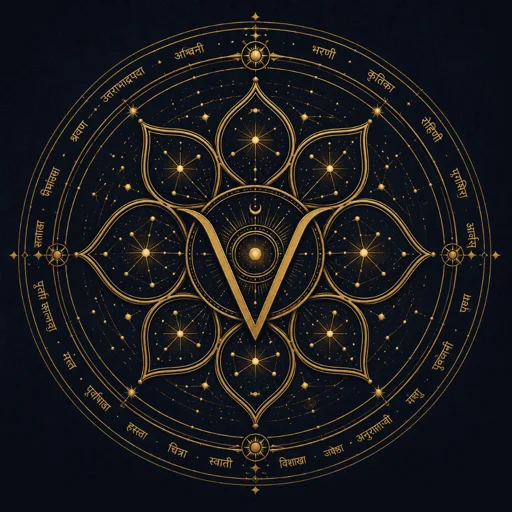
The parts of a birth chart and what they are called.
Kundliकुण्डली
Also seen as kundali, janam kundli, janma kundali, Vedic birth chart
A birth chart: a map of where the planets and signs stood when you were born.
Kundli is the everyday Indian word for a birth chart. It is drawn from your birth date, time and place. It lists each planet's sign and star, and the rising sign.
In Western terms: Same idea as a natal chart, drawn with the star-fixed zodiac.
See also: Birth chart, Lagna, Graha
Birth chart
Also seen as natal chart, horoscope
A map of the sky as it was at your birth, based on your date, time and place.
A birth chart shows where the Sun, Moon and planets were, and which sign was rising on the eastern horizon. Different traditions draw it in different ways. The Vedic version is called a kundli.
In Western terms: This is the same idea Western astrologers call a natal chart.
See also: Kundli, Lagna, Graha
Doshaदोष
Also seen as doshas
A pattern in a chart that the tradition treats as a point of difficulty. It is not a fault in you.
Some chart patterns are named doshas in traditional books, such as the one linked to Mars. Vediq does not use them to scare anyone. Readers often meet the word in matchmaking talk, where it is overstated.
In Western terms: It is a little like a 'hard aspect' in Western charts, a pattern the tradition marks as tense.
See also: Sade Sati, Graha
Yoga (in astrology)योग
Also seen as yogas, raja yoga
A named pairing of planets or signs in a chart that the tradition reads as a special theme.
Here, yoga does not mean the exercise practice. It means 'union' or 'combination'. Classical books list hundreds of named combinations, each with a traditional meaning.
In Western terms: It is similar to a Western chart pattern such as a stellium or a grand trine.
See also: Graha, Kundli
Grahaग्रह
Also seen as grahas, planet
A 'seizer': one of the nine bodies Vedic astrology tracks, including the Sun, Moon and two lunar points.
The nine grahas are the Sun, Moon, Mars, Mercury, Jupiter, Venus, Saturn, Rahu and Ketu. The tradition treats them as influences that shape timing and themes. Rahu and Ketu are not physical bodies.
In Western terms: Close to 'planets' in Western astrology, with Rahu and Ketu added and Uranus, Neptune and Pluto left out.
See also: Rahu, Ketu, Lord (ruler), Vimshottari
Rahuराहु
Also seen as north node, dragon's head
A point in the sky where the Moon's path crosses the Sun's, treated as a planet-like influence.
Rahu is not a body but a spot on the sky where eclipses happen. The tradition links it with hunger, novelty and the unusual. It is always exactly opposite Ketu.
In Western terms: It matches the North Node in Western astrology.
See also: Ketu, Graha
Ketuकेतु
Also seen as south node, dragon's tail
The point opposite Rahu on the sky, linked in the tradition with detachment and letting go.
Ketu is the second eclipse point, always across from Rahu. The tradition links it with what is already known, with release and with inner focus.
In Western terms: It matches the South Node in Western astrology.
See also: Rahu, Graha
Lagnaलग्न
Also seen as ascendant, rising sign
The zodiac sign rising on the eastern horizon at the moment you were born.
The lagna changes about every two hours, so it needs an accurate birth time. In Vedic charts it is the starting point for the houses. Many readings use it as the 'self' of the chart.
In Western terms: Same as the Ascendant or rising sign, but in the star-fixed zodiac.
See also: House (bhava), Kundli, Rashi
House (bhava)भाव
Also seen as bhava, houses
One of 12 areas of life in a birth chart, such as home, work or partnership.
A chart is split into 12 houses, counted from the rising sign. Each house stands for a field of life. Planets in a house are read as bearing on that field.
In Western terms: Works like Western houses, though the method of counting differs.
See also: Lagna, Graha, Kundli
Navamsaनवांश
Also seen as navamsha, D9
A closer view of a chart that splits each sign into nine parts, often used when looking at relationships.
Each sign is cut into nine equal parts of 3°20′, and each part is placed in a sign of its own. The result is a second chart read beside the main one. Each part equals one pada of a birth star.
See also: Pada, Rashi
Padaपाद
Also seen as charan, quarter
A quarter of a birth star, 3°20′ wide. Each star has four, so there are 108 in all.
Every birth star is split into four quarters called padas. Two people with the same birth star can have different padas. Each pada also falls in one of the 12 signs.
See also: Nakshatra, Navamsa
Lord (ruler)
Also seen as ruler, star lord, nakshatra lord, dasha lord
The planet that the tradition assigns to a birth star or sign, setting its tone.
Each of the 27 stars has a ruling planet in the timing system called Vimshottari. The planets repeat in a fixed order of nine, three times around. The ruler of your birth star decides where your life-cycle timeline begins.
In Western terms: Similar to a sign's 'ruling planet', such as Venus for Taurus, but here each star has one.
See also: Vimshottari, Dasha, Graha
Retrogradeवक्री
Also seen as vakri
When a planet seems to move backward against the stars, as seen from Earth.
Planets only look like they reverse, because Earth overtakes them in its orbit. The tradition reads a retrograde planet as working in a more inward or delayed way. Rahu and Ketu always move backward.
In Western terms: Same idea as Western retrogrades.
See also: Graha, Rahu
Guna Milanगुण मिलन
Also seen as Ashtakoota, ashtakuta, 36 points, kundli matching
The traditional way to compare two birth charts for a match, scored out of 36 points across eight areas.
Guna Milan compares the two Moons: their stars and signs. It scores eight areas called kootas and adds them up to 36. The tradition often reads 18 or more as workable. It is a conversation starter, not a verdict on a relationship.
In Western terms: Compare with Western synastry, but it is a fixed scoring sheet and looks only at the Moon.
See also: Koota, Nakshatra, Moon sign
Kootaकूट
Also seen as kuta, guna, kootas
One of the eight areas scored in a Guna Milan match, such as temperament, mind or health.
The eight kootas are Varna, Vashya, Tara, Yoni, Graha Maitri, Gana, Bhakoot and Nadi. Each carries a different number of points, from 1 to 8, which add up to 36.
See also: Guna Milan